Abstract
Introduction:
Lead is a potent neurotoxin that poses serious risks when it contaminates consumer products accessible to children. Toys, which are essential for fostering cognitive, physical, social and emotional growth during childhood, can become dangerous sources of lead exposure, along with children’s jewellery and certain cosmetics.
Objectives:
This study investigates lead contamination in children’s toys, jewellery and cosmetics available in Bangladesh.
Materials and Methods:
Purposively collected 250 children’s products (toys, jewellery and cosmetics primarily made of colourful plastic, metal and painted wood) from major markets in Dhaka city, Bangladesh were analysed. The samples were analysed using a Portable X-ray Fluorescence (XRF) Analyser. The data were analysed using descriptive statistics to assess the prevalence and severity of lead contamination in the samples. The percentage of samples exceeding the 90-ppm safety threshold was calculated.
Results:
Lead was detected in 62.8% of samples, and 58.6% exceeded 90 ppm safety threshold. Toys constituted the majority of lead (82.8%), followed by cosmetics (12.1%) and jewellery (5.1%). Plastic materials were the most common source of lead contamination (80.9%).
Conclusions:
There is an urgent need for stricter regulatory enforcement and increased public awareness to protect children in Bangladesh from lead exposure in consumer products.
Introduction
Play is essential to childhood, effectively promoting cognitive, physical, social and emotional development and establishing a strong basis for future success.[1] Toys serve not only as sources of entertainment but also as vital instruments for attaining developmental milestones. They associate education with entertainment by promoting creativity, stimulating the senses, and developing essential abilities that shape a child’s world perception.[2] Toys are also vital for motor skill development. Fine motor activities such as threading beads enhance hand–eye coordination and finger strength for tasks like writing. In contrast, larger toys like balls enhance gross motor skills, balance and agility. Similarly, toys like dolls promote social skills by encouraging role-play, rule negotiation and empathy, with imaginative play improving emotional regulation and understanding.[3] Despite their significant role in childhood development, toys can pose hidden dangers when contaminated with heavy metals like lead.
Lead, a potent neurotoxin, poses serious health risks to children even at low exposure levels. The Centers for Disease Control and Prevention 2024, USA,[4] categorically states that there is no safety limit for lead exposure. Lanphear et al. highlighted that lead exposure causes cognitive impairment, lower IQ and behavioural disorders in children.[5] This is particularly troubling given that children are highly vulnerable to lead poisoning, largely due to their frequent hand-to-mouth behaviour. Mouthing behaviour typically peaks between 6 and 12 months of age, during which children engage in such activity for approximately 39–66 min per day. This behaviour significantly increases their exposure to toxic metals present in toys and jewellery.[6]
Lead has been widely used in plastic toys to enhance brightness, durability and stabilising properties.[7] Studies highlight that lead contamination in toys often occurs in painted surfaces, plastics, and metal components, potentially exposing children through direct contact, ingestion, or hand-to-mouth behaviour.[8] Greenway and Gerstenberger[7] identified elevated lead levels in plastic toys collected from 10 day care centers in Las Vegas, Nevada. Out of 535 toys tested, 29 were found to contain lead exceeding 600 parts per million (ppm). Similarly, in an Indian study, 73% of samples having plastic materials had lead above permissible limits.[9] Statista reports that Bangladesh’s stuffed toys and hobby market is expected to reach US$3.39 billion in revenue by 2025, with an annual growth rate of 6.89% (Compound Annual Growth Rate 2024–2029), indicating significant growth potential.[10] However, the market’s dependence on imports and informal production raises concerns about product safety and regulatory compliance.
Despite global efforts to regulate lead content in children’s products, challenges persist, particularly in the face of imported goods from regions with lax enforcement. Regulatory bodies like the European Union (under REACH regulations) and the United States (under the CPSIA of 2008) have set strict limits on lead levels, yet gaps in compliance remain. A 2019 study by Larson and Jordan[11] examines the global issue of toy safety and recalls, emphasising that many recalls, particularly for lead violations, often stem from inadequate regulatory adherence in production regions. Although newspaper reports have occasionally raised concerns about lead contamination risks in children’s toys in Bangladesh, no comprehensive scientific investigation has yet assessed lead levels in toys sold in local markets. This study therefore aims to address this critical knowledge gap by systematically quantifying lead concentrations in a representative sample of toys commonly available in Bangladeshi markets using standardised analytical methods; identifying the types of toys and specific components (e.g. paints, plastics and metal parts) most likely to contain elevated lead levels and providing evidence-based recommendations for policymakers, manufacturers, importers and regulators to improve toy safety and protect child health in Bangladesh.
Materials & Methods
This study used a purposive, market-based surveillance design rather than a prevalence-estimation design; therefore, the sample size was not derived from a statistical power formula. The primary objective was to obtain a sufficiently broad and diverse set of children’s consumer products that are widely available in Dhaka markets in order to screen for potential lead contamination.
The study was conducted in Dhaka District, within market areas of Dhaka North and Dhaka South City Corporations, which represent the major commercial hubs for children’s consumer products in the capital. Major retail and wholesale markets in Dhaka (Bashundhara City, Orchid Plaza, New Market, Chowk Bazar, Rayer Bazar City Corporation Market and Krishi Market) were purposively selected because they represent the most frequented purchasing points for children’s products in the capital. Within these markets, children’s toys, jewellery and cosmetics made of colourful plastic, metal and painted wood were collected between September and November 2024.
A total of 250 items was chosen based on practical feasibility, laboratory capacity, budget and the need to ensure adequate representation of different product categories, brands, materials, and colours. This sample size allowed inclusion of multiple product types across several markets while remaining manageable for laboratory analysis.
The proportions of toys, jewellery and cosmetics within the 250 samples were determined purposively to reflect the relative market availability and sales popularity of these items, as reported by vendors. Priority was given to products that were commonly sold, inexpensive and readily accessible to the public, as these pose the greatest potential exposure risk to children.
Sample preparation
All samples were analysed using a Portable X-ray Fluorescence (XRF) Analyser (Olympus Vanta C Series HH XRF Analyser), a non-destructive technique that employs X-rays to rapidly determine the elemental composition of materials, with detection limits as low as 1 ppm. Specimens were prepared by cleaning to remove surface contaminants, dirt and dust; solid objects required no additional preparation. The procedure for testing lead (Pb) content in toys, jewellery and cosmetics is detailed below.
Selection of mode
The XRF analyser was set to the appropriate mode based on the material being tested: plastic mode for toys, metal mode for jewellery and cosmetics mode for makeup products. A screening threshold aligned with safety regulations is 90 ppm for lead content in items manufactured and marketed for children, set by the US Consumer Product Safety Commission in 2010 under the Consumer Product Safety Improvement Act of 2008.[12] For cosmetics, the US Food and Drug Administration typically sets the limit for lead in colour additives at 10–20 ppm.[13]
Instrument calibration
Before analysis, the XRF analyser was calibrated with certified reference standards of known lead concentration to ensure accurate measurements. First, the analyser was powered on and allowed to warm up in accordance with the manufacturer’s specifications. Next, the appropriate calibration mode was selected based on the material type, such as plastic, metal or painted surfaces. Finally, certified reference materials, including lead-free samples and samples with known lead concentrations (e.g. 90 ppm), were used to calibrate the device, ensuring precision in subsequent measurements.
Testing of toys
Toy samples were placed on a flat surface, and the XRF analyser was positioned in direct contact with the area being tested (e.g. plastic parts and painted surfaces). The device scanned the sample for 30–60 s and recorded lead concentrations.
Testing of jewellery
Jewellery samples were tested by placing the XRF analyser on the metal or coated surface, ensuring complete contact with the sample. After scanning, lead concentrations were recorded, and multiple areas were tested if different materials (e.g. painted or enamelled surfaces) were present.
Testing of cosmetics
The XRF analyser was used to scan makeup products in their original packaging to detect lead concentrations in powders, lipsticks or creams. A compressed pellet could be prepared to obtain more precise results for powdered makeup, although surface scanning was typically sufficient.
Quality control
Several techniques were applied to ensure the accuracy and reliability of the study results. Duplicate measurements were performed on at least 10% of the samples to verify consistency, and additional tests were conducted to assess whether significant variation was observed. Lead-free materials were periodically analysed to assess contamination or instrument errors. Reference standards were also re-analysed regularly to confirm that the XRF analyser remained accurate throughout the testing process. These measures ensured the reliability and validity of the findings.
Statistical analysis
Data were analysed using descriptive statistics to summarise the characteristics of the sampled products and the prevalence of lead contamination. Frequencies and percentages were calculated for categorical variables, including product type (toys, jewellery, cosmetics), material composition (plastic vs. non-plastic), colour, geographic origin and lead detection status (positive/negative and above/below the 90 ppm safety threshold). Associations between lead levels (dichotomised as ≥90 ppm vs. <90 ppm) and categorical variables (product type, colour and material) were assessed using Fisher’s exact tests, given the categorical nature of the data and the presence of cells with expected counts <5 in some contingency tables. P < 0.05 was considered statistically significant. All analyses were performed using the Statistical Package for the Social Sciences (SPSS) version 27, manufactured by IBM Corporation, Armonk, New York, United States. The manuscript was prepared in accordance with the Strengthening the Reporting of Observational Studies in Epidemiology (STROBE) guidelines.
Ethics approval
This study was conducted in accordance with ethical guidelines, and no formal ethical approval for human or animal subjects was required, as it involved the analysis of lead contamination in children’s toys, jewellery, and cosmetics without direct human or animal testing. All samples were collected from local markets, and no personal data or confidential information was obtained. The research adhered to relevant safety and environmental standards, with a focus on raising awareness of lead contamination in consumer products for public health and regulatory compliance. The authors declare no conflicts of interest and ensure full transparency in the reporting of results.
Results
Table 1 presents the general characteristics of the sampled products (n = 250), highlighting that the vast majority are composed of plastic (81.6%). Toys dominate the product categories, representing 84.8% of all items, followed by cosmetics (10.4%) and jewellery (4.8%). In terms of geographic origin, half of the products were manufactured in China (50.4%), followed by Bangladesh (34.4%) and a mix of other countries (15.2%). Colour-wise, yellow and pink are the most common product colours (16.4% each), with green (14.0%), red (13.2%) and blue or orange (10.8% each) also being frequently represented. A significant concern emerges in the lead content analysis: 62.8% of the products tested positive for lead. Among these, 58.6% had lead concentrations equal to or exceeding the regulatory safety limit of 90 parts per million (ppm), indicating substantial non-compliance with safety standards.
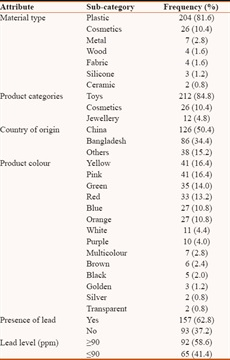
Table 1: Distribution of product characteristics and lead content (n=250)Lead concentrations in the 250 samples ranged from below the detection limit (<1 ppm) to 1,380 ppm, with a mean of 148.5 ppm (standard deviation [SD] = 212.3 ppm) and a median of 68 ppm. Amongst the 157 lead-positive samples (62.8%), the mean lead concentration was 236.4 ppm (SD = 248.7 ppm), with a range of 5–1380 ppm.
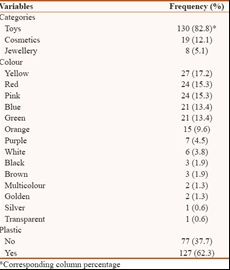
As shown in Table 2, toys remain the dominant contributor among lead-positive items, accounting for 82.8% of such products. Cosmetics and jewellery account for smaller shares, at 12.1% and 5.1%, respectively. Among colour categories, products in yellow (17.2%), red (15.3%), and pink (15.3%) exhibited the highest frequencies of lead presence. Notably, plastic materials are highly associated with lead content, with 62.3% of plastic products testing positive.
One particularly concerning finding was a plastic children’s drinking cup with a lead concentration of 1380 ppm, more than 15 times the reference threshold and indicative of a serious potential exposure risk. This highest value was obtained from a single XRF scan and was not independently confirmed by repeat measurement; nonetheless, the magnitude of exceedance suggests possible extreme contamination and warrants confirmatory testing and further investigation.
Table 3 presents the distribution of products with lead levels above and below the reference threshold, categorised by product type, colour and material composition. A statistically significant association was observed between product category and lead levels (P = 0.004). Specifically, 74.4% of toys had lead levels above the reference threshold, compared to only 18.9% of cosmetics and 6.7% of jewellery items. The relatively low percentages for cosmetics and jewellery were accompanied by non-significant results for jewellery (P = 0.556), while the association for cosmetics was statistically significant (P = 0.018).
Distribution of lead levels amongst lead-positive products
Regarding colour, no statistically significant associations were found between product colour and lead levels (all P > 0.05). However, some colours, such as pink (17.8%) and orange (12.2%), showed higher proportions of products exceeding the reference level, although these differences were not statistically significant.
Regarding material composition, a significant association was observed between the presence of plastic and lead levels (P = 0.048). Amongst plastic products, 75.6% exceeded the lead reference level, whereas 24.4% of non-plastic items did. This suggests that products made of or containing plastic are more likely to surpass safety thresholds for lead content.
Table 4 presents additional descriptive statistics for lead concentrations by product category and material type, further illustrating higher mean and median levels in toys and plastic items than in other categories.
Descriptive statistics of lead concentrations (ppm) by product category and material type (n=250)
Discussion
This study offers crucial insights into the widespread lead contamination found in children’s consumer products, specifically toys, jewellery and cosmetics, sold in prominent marketplaces across Dhaka, Bangladesh. The results reveal alarmingly high levels of lead contamination, especially in plastic toys, highlighting a substantial public health threat.
Our findings reveal that plastic toys exhibit the highest lead contamination rate, with 82.8% of all contaminated samples belonging to this category. This aligns with findings from other South Asian countries. For example, in India, Dutta et al.[9] reported that 66% of sampled toys contained detectable levels of lead, and 31% exceeded the permissible limit of 90 parts per million (ppm). Similarly, in Nepal, Suwal et al.[14] found hazardous levels of lead, chromium, and zinc in hard plastic toys, often breaching international safety standards. Research in Pakistan by Shahzad et al.[15] also noted significant lead contamination in toys sourced from informal, unregulated markets. These studies collectively point to a broader regional challenge wherein weak regulatory enforcement, minimal industrial oversight and widespread reliance on informal manufacturing processes contribute to persistent lead contamination in children’s products.
The categorisation of lead levels reveals that toys were most frequently found to exceed the permissible 90 ppm threshold, highlighting a significant issue of non-compliance within the toy industry. In our study, 75.6% of plastic toys exceeded the accepted lead limit, consistent with a similar study conducted in India, which found that 31% of plastic toys exceeded the threshold. This suggests a widespread concern about lead contamination in plastic toys across different regions.[9]
In our study, toys were shown as the dominant contributor to lead-positive items, which is similar to numerous studies worldwide that have identified children’s toys as a primary source of lead exposure.[16] Specifically, plastic materials were highly associated with lead content in our study, with 62.3% of plastic products testing positive. This is corroborated by global research indicating that plastic toys, especially those made from recycled plastics, frequently contain elevated levels of lead and other toxic elements.[17-19]
The findings also show that products originating from both China and Bangladesh exhibited higher lead contamination rates. Many of the inexpensive toy jewellery items available in Dhaka’s markets are imported from China, a pattern corroborated by Weidenhamer and Clement,[20] who found that over half of the tested Chinese-imported children’s jewellery contained unsafe lead levels. In Bangladesh, the problem is exacerbated by the presence of informal manufacturing units that often operate outside the purview of regulatory bodies. These local manufacturers typically lack both awareness and incentive to comply with international safety protocols, leading to the unchecked circulation of hazardous goods.
Another dimension of the study pertains to the presence of lead in children’s jewellery and cosmetics. These products, though often overlooked in policy discourse, present substantial risks. Jewellery for children frequently incorporates lead-based alloys to enhance durability and visual appeal. Similarly, lead may be used in cosmetics as a stabiliser or pigment. Witkowska et al.[21] noted that the dermal and oral exposure routes associated with these items, especially lip-based cosmetics, can lead to chronic exposure.
Rouzi et al.[22] documented elevated lead concentrations in umbilical cord blood among newborns in Morocco, underscoring the risks of prenatal exposure and the need for health surveillance programs to protect infants from early toxic metal exposure. Altogether, the findings underscore a systemic issue extending beyond individual products or marketplaces. The presence of lead in toys, jewellery and cosmetics reflects gaps in manufacturing practices and a dire need for robust policy interventions. These should include mandatory product testing, tighter control of imports, certification protocols for locally manufactured goods and awareness campaigns targeting producers and consumers.
Interestingly, no significant association was found between lead contamination and the colour of the products in this study, although the red, yellow and pink products had the highest frequencies of lead contamination. In contrast, a significant association was found between the paint of toys and lead levels (P < 0.05).[23] This lack of correlation may suggest that the lead contamination is more closely linked to the materials used in the toys (especially plastic) rather than their external appearances. A study conducted by Suwal et al. revealed that hard plastic toys have a very high concentration of heavy metals like lead, chromium and zinc, and exceed the compliance rate for barium and bromine.[14]
The predominance of lead in plastic toys underscores material-specific vulnerabilities in manufacturing, where lead may be inadvertently or intentionally added during production to reduce costs or enhance properties. This highlights the need for material-focused testing and regulation to address inherent risks in commonly used substrates.
A healthy environment is understood as one that ensures clean air, stable climate, sufficient water, sanitation and hygiene, safe handling of chemicals, protection from radiation, secure workplaces, sustainable farming practices, supportive urban and built spaces and the preservation of natural ecosystems – all of which are vital for human well-being.[24] Within this framework, the continued presence of lead in children’s products highlights a serious lapse in safeguarding these essential health determinants, directly threatening children’s right to grow and develop safely.
The findings of this study are directly relevant to preventive medicine and the strengthening of primary health care systems in low-and middle-income countries (LMICs). Lead poisoning is entirely preventable, and PHC facilities can play a central role in early detection through routine screening, counselling of families and community-based surveillance of toxic exposures. Integrating lead monitoring within maternal and child health programmes would help prevent long-term neurological and developmental damage.[25]
Policy implications extend to establishing national product safety regulations, strengthening import controls, and embedding toxic metal surveillance into PHC initiatives.[26] This approach is similar to India’s Health and Wellness Centres model, which emphasises preventive and promotive care.[27] Such integration would ensure that consumer product safety is recognised as a public health priority and addressed through coordinated health system interventions in LMIC contexts.
Conclusions
This study underscores a critical yet often overlooked threat to child health and development in Bangladesh. The findings confirm that children’s toys, jewellery and cosmetics are widely available in popular marketplaces and are frequently contaminated with lead at hazardous levels. Given the profound and lifelong consequences of early lead exposure, including neurodevelopmental disorders, diminished educational outcomes and reduced socioeconomic potential, urgent action is required. As Bangladesh’s market for children’s products continues to expand, establishing a strong, enforceable regulatory framework is not merely desirable but essential. It must be coupled with market monitoring, public education and industrial reform to ensure that preventable environmental toxins do not compromise any child’s health. The evidence presented here serves as both a warning and a call to action: children’s safety must become a national priority grounded in science, policy and collective responsibility. To effectively combat lead contamination in children’s products, the health sector can lead surveillance and screening, the commerce and industry sector can enforce stricter manufacturing and import standards, and consumer protection agencies can ensure rigorous market oversight and enforcement – all through coordinated multisectoral collaboration.
Relevance to preventive medicine:
Detecting lead in children’s products highlights a major environmental health hazard. Preventive strategies – such as strict regulatory enforcement, routine product testing, and public awareness – are vital to reducing exposure and protecting children’s long-term cognitive and developmental health.
Implications for clinical practice:
Clinicians should consider environmental lead exposure when evaluating developmental delays or behavioural disorders in children. Early screening, parental counselling and community-level advocacy can help mitigate risks and guide timely interventions.
Authors’ contributions
SH, SS conceptualised the study, contributed to the methodology, and wrote the introduction and discussion sections. SS, FN and AT performed the data analysis and wrote the results section. FN, SAT and SSJ assisted in the literature review and contributed to the writing of the introduction. SAT was responsible for data collection and statistical analysis. SSJ, AT and MAH contributed to the methodology and provided support for data interpretation. AT assisted in manuscript writing and revisions. MAH supervised the study, guarantor of the manuscript, revised the manuscript critically for important intellectual content and provided final approval. All authors reviewed and approved the final manuscript.
Data availability statement
The data supporting this study’s findings are not publicly available but can be obtained from the corresponding author, Dr Md Atiqul Haque (email: atiqulm26@bsmmu.edu.bd), upon reasonable request.
Adherence to reporting guidelines
This study was reported in adherence to the Strengthening the Reporting of Observational Studies in Epidemiology (STROBE) reporting guidelines, as recommended by the EQUATOR Network, to ensure transparency, completeness, and methodological rigor in reporting.
Use of AI in the drafting of the manuscript
The authors haven’t used any generative AI/AI-assisted technologies in the writing process.
Financial support and sponsorship
Nil.
Conflicts of interest
There are no conflicts of interest.
Acknowledgement
We gratefully acknowledge Ban Toxics for their collaboration in this study. They provided both physical and technical support, including access to the XRF analyser, with testing conducted by their certified expert. Their contribution was instrumental in enabling us to carry out the necessary research and assessments.